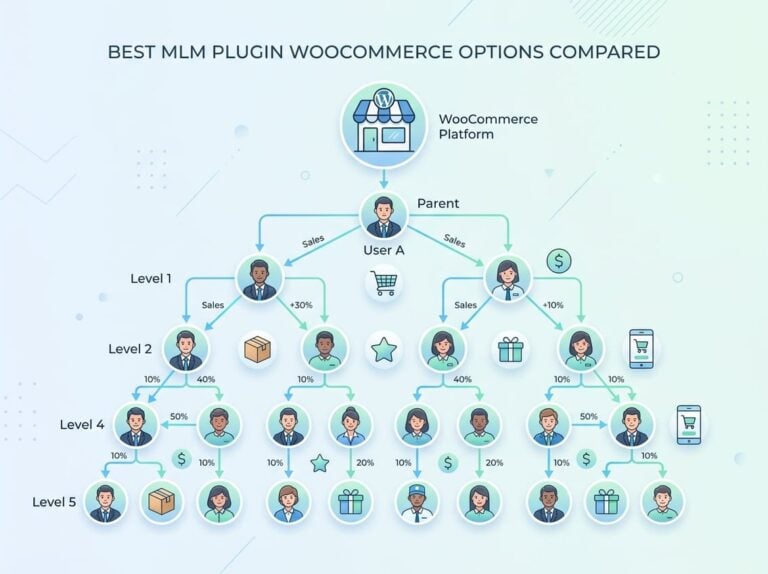
Most affiliate programs treat every referral the same: someone clicks, someone buys, you get paid. A matrix MLM affiliate program works differently. It builds a structured team network with hard limits on how wide and how deep your downline can grow, and those limits are what drive the whole payout system.
If you run a membership site, a subscription box, or any offer where recurring revenue matters, a forced matrix structure can turn your affiliate program into a self-filling network where early members benefit from the activity of people they never personally recruited.
That spillover mechanic is what separates a matrix setup from a basic two-tier referral program. It also makes the configuration more complex. You need to think through width, depth, commission rates per level, and how your software handles placement before you launch anything.
This guide covers the practical setup: how the structure works, where it fits, what your tracking needs to handle, and how to configure it inside Ultimate Affiliate Pro.
How A Forced Matrix Structure Works In Practice
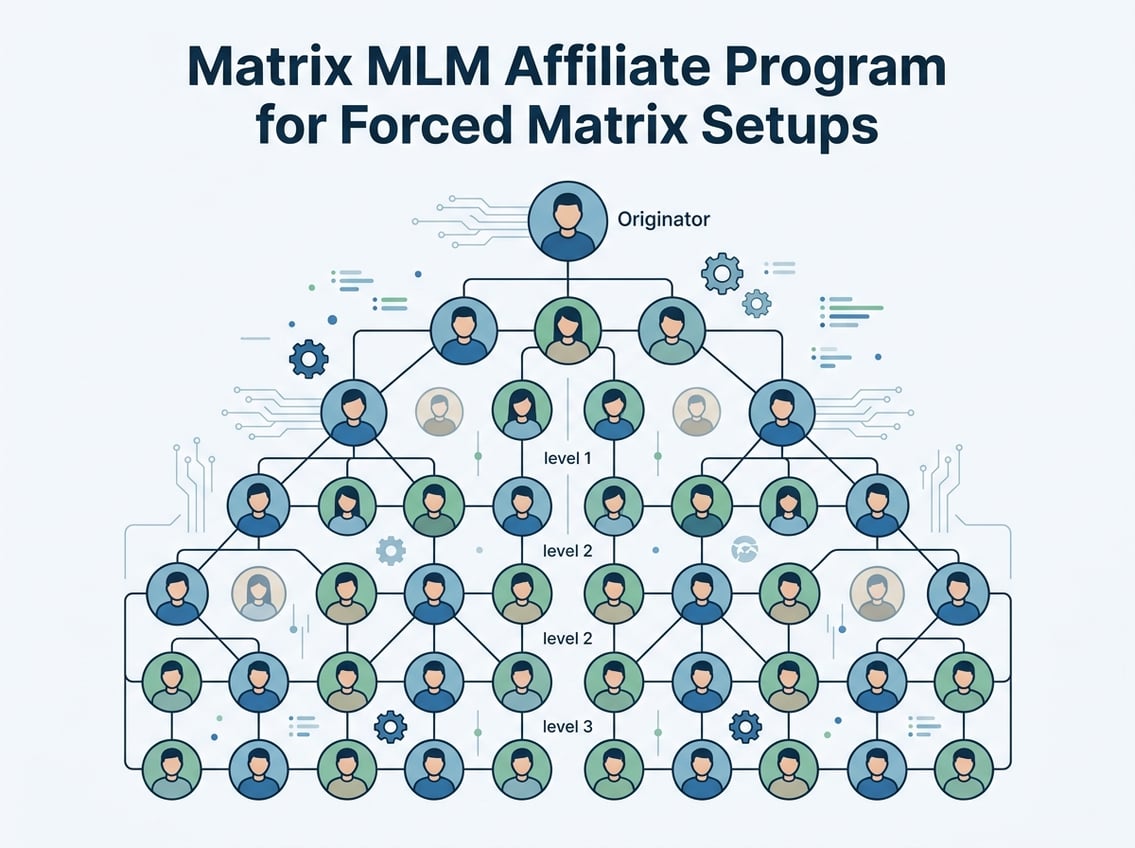
A forced matrix plan is defined by two numbers: width and depth. Every other rule in the system flows from those two constraints. Width caps how many direct recruits any single distributor can have on their first level. Depth caps how many levels deep the commission tree extends.
Fixed Width And Depth Rules
In a 3×5 matrix structure, each position can hold exactly three direct recruits, and the tree runs five levels deep. As noted in an overview of matrix plan mechanics, that single configuration produces 363 total positions in one distributor’s matrix.
Common configurations include:
- 2×12: Narrow width, very deep; common for cycling programs
- 3×9: Moderate width and depth; used in subscription-based networks
- 5×5: Wider and shallower; good for high-ticket offers with small active teams
- 4×7: Balanced option for mid-size membership programs
The fixed width rule is what makes this a forced matrix. You cannot place more than the allowed number of people on any single level.
How The Matrix Tree Fills
Positions fill left to right, top to bottom. When your first-level slots are taken, new recruits flow into the next available spot below them. This is automatic in most matrix MLM software. The system places each new distributor into the tree based on position availability, not manual choice (unless your software supports manual placement as an option).
Spillover, Upline, And Downline Placement
Spillover is what happens when a distributor’s first-level positions are already full. The new recruit “spills over” into the next open slot below, which typically ends up under someone else in your downline. According to Post Affiliate Pro’s explanation of forced matrix programs, this spillover dynamic encourages teamwork because active upline members directly benefit the people below them.
Your upline is everyone above your position in the tree. Your downline is everyone below. When a new member joins above you and their slots are full, you may receive that recruit as your downline without doing any direct recruiting yourself.
Why Matrix Plans Differ From Unilevel
In a unilevel plan, there is no width cap. You can recruit as many people as you want on your first level, and commissions pay down a set number of levels from there. A matrix MLM plan removes that flexibility. The binary vs. unilevel vs. matrix comparison from FlawlessMLM sums it up well: unilevel rewards personal recruiters who build wide; matrix rewards early participants who benefit from structured spillover.
Commission Logic That Makes Or Breaks The Model
The compensation plan inside a matrix MLM determines whether your affiliates stay active or go quiet after their first few referrals. A flat percentage per level works, but layering in matching bonuses and recurring commissions is what keeps earnings growing over time.
Referral Commissions On Direct Sales
Your referral commissions are the base layer. These are paid when someone in your downline makes a sale or a new member joins. In a matrix, you typically set a percentage per level, and that rate often decreases as you go deeper.
A simple example for a 3×3 matrix:
| Level | Positions | Commission Rate |
|---|---|---|
| 1 | 3 | 10% |
| 2 | 9 | 6% |
| 3 | 27 | 3% |
Keeping level-one rates higher rewards direct recruiting while still giving everyone a reason to care about deeper activity.
Matching Bonus And Matching Bonuses
A matching bonus pays you a percentage of what your direct recruits earn. If your level-one affiliate earns $100 in commissions and you have a 20% matching bonus, you collect $20 on top of your regular commissions. Matching bonuses are common in matrix MLM plans because they give top recruiters an extra incentive to help their direct downline succeed.
Some programs stack matching bonuses across two or three generations. This gets complicated fast, so only add that layer if your tracking system can handle it cleanly.
Payout Depth Versus Profit Control
Every level you pay eats into your margin. Before you finalize your commission structure, run the math on a full matrix at maximum depth. In a 3×5 matrix with commissions paid on every level, you could be paying out across 363 positions. That is manageable if your product has high margins. It is a serious problem if you are selling low-ticket items with thin margins.
Practical options for controlling cost:
- Pay commissions only on levels 1 through 3, regardless of matrix depth
- Set lower flat rates on levels 4 and 5
- Require a minimum personal sales volume to unlock deeper level earnings
Recurring Revenue For Memberships And Subscriptions
This is where the matrix MLM affiliate program model genuinely earns its complexity. If you sell a monthly membership or a subscription product, commissions can recur every billing cycle. Your affiliates earn every month their downline members stay subscribed, not just on the initial sale. Over a 12-month period, a subscription with a 10% referral commission on a $50/month plan pays $60 per referred member rather than a one-time $5.
Where This Model Fits Best For WordPress And WooCommerce Sites
Not every site benefits from the extra structure a matrix plan requires. The setup overhead is real, so it makes sense only when the revenue model justifies it.
Paid Membership And Course Sites
If you run a paid membership site, a forced matrix gives your affiliate program a built-in retention incentive. Affiliates earn recurring commissions as long as their referred members stay subscribed. The structure also fills itself over time as active members recruit others into the network.
Subscription Products And Repeat Orders
Subscription boxes, SaaS tools, and consumable products with monthly replenishment cycles are strong candidates. The recurring commission model rewards affiliates for bringing in sticky customers rather than one-time buyers.
High-Ticket Offers With Small Teams
A 5×5 or 4×4 matrix works well for high-ticket coaching programs or masterminds where you expect a small, committed group of distributors. The width is wide enough that spillover is limited, but the team stays manageable and commission payouts are meaningful per transaction.
When A Simple Referral Setup Is Not Enough
If your affiliates are actively recruiting other affiliates, and those sub-affiliates are also driving sales, a single-tier or basic two-tier setup leaves a lot of motivation on the table. A matrix plan gives you a structured way to reward that multi-generation activity without building a completely open-ended unilevel network.
Tracking, Automation, And Network Management Requirements
Running a matrix manually is not realistic past a dozen members. The placement logic, spillover handling, and multi-level commission calculations need to be automated from the start.
Commission Tracking Across Levels
Your software needs to calculate commissions accurately for every transaction at every level. This means tracking who referred whom, where each person sits in the matrix tree, and what commission rate applies to their position. As the commission engine guide from Infinite MLM Software points out, matrix systems trigger payouts based on structure completion rules, which requires the engine to evaluate tree position before calculating any payment.
Placement Rules And Spillover Handling
The system needs a clear placement algorithm. Most matrix MLM software defaults to breadth-first filling (left to right, top to bottom), but some platforms let you override placement manually or by sponsor preference. Decide this before launch because changing it after the tree starts filling creates accounting problems and frustrated affiliates.
Wallets, Payouts, And Approval Workflows
You need a way to accumulate commissions before paying them out. An in-platform wallet lets you hold earned commissions, apply minimum payout thresholds, and batch process payments on a schedule. Manual per-transaction payouts are not practical in a growing matrix network. Look for PayPal, bank transfer, or store credit payout options at minimum.
Reporting Needs For Growing Programs
Your affiliates want to see their matrix tree, their earnings per level, and their pending commissions. Your admin team needs export tools, payout history, and the ability to flag refunds or charge-backs before they affect commission balances. Without solid reporting, you will spend significant time managing disputes manually.
Setting Up The Plan In Ultimate Affiliate Pro
Ultimate Affiliate Pro is the most capable WordPress plugin for running a matrix MLM affiliate program natively inside your WooCommerce or membership site. It supports matrix plan configuration directly, with controls for width, depth, and per-level commission rates, without needing custom code or a separate SaaS platform.
Matrix Plan Configuration Basics
Inside Ultimate Affiliate Pro, the MLM settings let you define your matrix structure and assign commission percentages per level. Once configured, the plugin builds the matrix tree automatically as affiliates join. You can display the MLM matrix on each affiliate’s dashboard so they can track their position and downline activity in real time.
The plugin handles both the placement logic and the commission calculation in one environment, which removes the integration complexity you would face with standalone MLM software connected to WooCommerce via webhooks.
Choosing Width, Depth, And Payout Rules
When you set up your forced matrix plan, decide your width and depth first. Then assign a commission rate to each level. Ultimate Affiliate Pro lets you configure different rates per level, so you can front-load higher commissions on level one and taper as you go deeper. You can also set minimum rank or sales volume requirements before an affiliate unlocks deeper levels, which protects your margins.
Combining Direct Commissions With MLM Rewards
One of the more practical features is the ability to combine direct affiliate commissions with MLM-style multi-level commissions. An affiliate can earn a flat referral commission on their own direct sales and also earn percentage commissions from their downline’s activity. This hybrid approach works well for course or membership sites where you want standard affiliate behavior plus a recruitment incentive layer.
For a practical overview of how this payout logic flows across levels, the MLM affiliate commission structure guide on the Ultimate Affiliate Pro site walks through common configurations. If you are ready to compare plans and pricing, the Ultimate Affiliate Pro pricing page shows what is included at each tier.
When To Compare Affilia And Other Alternatives
Affilia (available on WordPress.org) offers a lighter affiliate and MLM setup for WooCommerce. It works for basic multi-tier referral programs but lacks the granular matrix configuration and per-level commission control that Ultimate Affiliate Pro provides. For simple two or three-tier setups without strict width or depth rules, Affilia covers the basics at a lower entry cost.
If your plan involves a true forced matrix with defined width, spillover handling, and recurring commissions across multiple levels, Ultimate Affiliate Pro is the more complete solution. Competitors like AffiliateWP focus on standard affiliate tracking and do not natively support matrix plan structures.
Frequently Asked Questions
How does a forced matrix commission structure actually work, and who gets paid when your downline is incomplete?
In a forced matrix, commissions are paid based on position in the tree, not just on personal recruits. If your downline is incomplete (meaning some positions are empty), you simply do not earn commissions for those unfilled slots. There is no penalty, but there is also no payout until those positions are occupied either by your own recruits or by spillover from above.
What WooCommerce affiliate plugins support matrix-style payouts without custom development?
Ultimate Affiliate Pro is the primary WordPress plugin that supports matrix plan configuration natively inside WooCommerce. It handles placement logic, per-level commission rates, and affiliate dashboards without custom development. Most other WooCommerce affiliate plugins support only single-tier or basic multi-tier setups and do not include forced matrix mechanics.
How do you handle refunds, chargebacks, and subscription cancellations so commissions don’t get overpaid?
The safest approach is to hold commissions in a pending state for a defined window (typically 15 to 30 days) before releasing them for payout. When a refund or cancellation occurs within that window, the system reverses the commission before it is paid out. For subscription cancellations, commissions on future billing cycles simply stop generating once the subscription lapses.
What’s the cleanest way to track referrals and placement (sponsor vs. upline) inside WordPress without breaking caching?
Use server-side cookie tracking with a long referral window rather than relying on JavaScript-only cookie storage. Ultimate Affiliate Pro handles referral tracking through its own cookie and session logic, which remains functional with standard WordPress caching plugins. The distinction between sponsor (who recruited you) and upline (everyone above you in the tree) is stored in the database, not in the cookie, so caching does not affect placement accuracy.
Which payout method is least painful for a growing affiliate network: PayPal MassPay, bank transfer, or store credit?
Store credit is the lowest-friction option for early-stage programs because it eliminates payment processing fees and keeps revenue inside your platform. PayPal works well once your affiliate base is established and your payout volumes are predictable. Bank transfer is the most reliable for larger payouts but requires more administrative setup for international affiliates.
What disclosures, terms, and compliance checks should you add to avoid your program being flagged as a pyramid scheme?
Your program must tie all commissions to actual product sales or subscriptions, not to recruitment fees alone. Include an income disclosure statement in your affiliate terms, and make clear that earnings depend on genuine sales activity. Requiring affiliates to make personal purchases before earning commissions from their downline is a red flag regulators look for, so avoid any mandatory purchase-to-participate requirement.