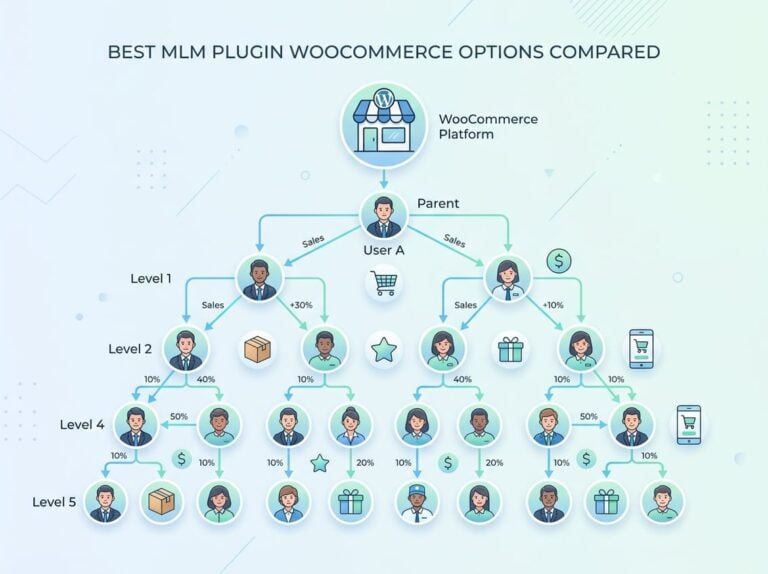
A multi-level affiliate program (also called an MLM or multi-tier affiliate program) pays affiliates for the sales they refer plus a smaller commission on sales made by affiliates they recruit, across two or more levels. You still pay only when a real customer buys. Ultimate Affiliate Pro builds this into its core WordPress plugin.
Done right, this structure helps your program grow by rewarding collaboration and team-building inside your affiliate network. Done wrong, it becomes too complex to manage or drifts toward recruitment for its own sake. This guide covers how a multi-level affiliate program works, how it compares with single-tier programs and tiered rates, the pros and cons for your business, the legal lines you must respect, and the exact steps to build one in WordPress with Ultimate Affiliate Pro’s MLM feature.
How a Multi-Level Affiliate Program Works
Every multi-level program rests on one relationship: parent and sub-affiliate. When an affiliate invites someone who then signs up as an affiliate, the inviter becomes the parent and the new member becomes their sub-affiliate. That sub-affiliate can recruit sub-affiliates of their own. Everyone below an affiliate in that chain is their downline; everyone above is their upline.
Each step up the chain from the affiliate who made the sale is a level (or tier):
- The selling affiliate earns their normal commission on the customer’s purchase.
- Level 1 is that affiliate’s direct parent, who earns an MLM commission on the sale.
- Level 2 and beyond are the parent’s parent and so on, each earning a smaller MLM commission, up to the depth you set.
Commissions only flow upward when a customer actually buys. Recruiting someone earns nothing by itself; it only creates the chain that later sales pay along. That one rule is what keeps a multi-level affiliate program on the right side of the line between affiliate marketing and a pyramid scheme.
A Simple Example
Illustration with hypothetical rates. John recruits Sarah, and Sarah recruits Mike. Your store pays affiliates 30% on the sales they refer, and your MLM settings pay Level 1 at 10% and Level 2 at 5%. Mike refers a customer who buys a $200 product:
| Affiliate | Position | Rate | Earns |
|---|---|---|---|
| Mike | Made the sale | 30% of the $200 order | $60 |
| Sarah | Level 1 (Mike’s parent) | 10% of Mike’s $60 referral | $6 |
| John | Level 2 (Sarah’s parent) | 5% of Mike’s $60 referral | $3 |
In Ultimate Affiliate Pro, MLM levels are calculated from the referral amount of the affiliate who made the sale by default, as in the table. If you prefer upline commissions based on the product price instead, the MLM based on product price option switches the base: with the same rates, Sarah would earn 10% of the $200 order ($20) and John 5% ($10). Choose the base that your margins can support.
This network effect is the point of the model. Affiliates who recruit well-matched partners keep earning as those partners sell, so they have a reason to bring in good people and help them succeed.
Multi-Level vs Single-Tier vs Tiered Rates
Three program types get confused all the time. A single-tier program pays only the referring affiliate. A multi-level program also pays the affiliate’s upline. A program with tiered rates pays one affiliate a higher rate as their own results grow, which has nothing to do with recruiting. You can combine them, but they solve different problems.
| Single-tier | Multi-level (MLM) | Tiered rates | |
|---|---|---|---|
| Who earns on a sale | The referring affiliate only | The referring affiliate plus their upline | The referring affiliate only |
| What changes the payout | Nothing; one rate | Position in the recruitment chain | The affiliate’s own sales volume or rank |
| Recruiting rewarded? | No | Yes, through downline sales | No |
| Admin effort | Lowest | Highest: tree, levels, more payouts | Medium: thresholds and ranks |
| Best for | Simple programs and most stores | Community-driven brands where affiliates know other potential affiliates | Rewarding top performers without recruitment |
| Learn more | Affiliate marketing vs MLM | Multi-tier affiliate program software | Tiered affiliate commissions |
Single-tier programs suit products where you just need people to drive direct sales. Multi-level structures work best when your affiliates are marketers, creators, coaches or community members who naturally know other people who could promote you. Many programs start single-tier and add a second level once they have a core of active affiliates.
Pros and Cons for Your Business
Advantages
- Stronger motivation to recruit. Affiliates bring in new partners because they also earn from their team’s sales.
- Faster network growth. Your affiliate base can grow through your affiliates’ own contacts instead of only through your recruiting.
- Better retention and loyalty. Affiliates with an active downline have more reason to stay, since they keep earning from their team’s ongoing activity.
- Built-in mentoring. Parents have a financial reason to train their sub-affiliates, which takes some of the onboarding load off you.
- A good fit for community-driven brands. Membership sites, SaaS products, courses and coaching programs, where word of mouth already matters, benefit most.
Disadvantages (and How to Manage Them)
- Complex commission structure. Multiple levels are hard to calculate by hand. Solution: let your affiliate plugin calculate every level automatically from the rates you set.
- Risk of a recruitment focus. If rewards depend mainly on sign-ups instead of real sales, the program drifts toward a pyramid scheme. Solution: pay only on completed customer purchases, never on sign-ups or joining fees.
- Higher total commission cost. Every paid level adds another commission to each sale. Solution: add up the rates across all levels and keep the total inside your margin; two or three levels are enough for most stores.
- Harder performance tracking. With several layers of affiliates, you need to see who earned what and why. Solution: use referral reports that show each MLM commission separately, and give affiliates a view of their own downline.
- More payouts. One sale can create three or four commissions. Solution: use bulk payouts and a minimum payout threshold.
- More room for abuse. Fake sign-ups and self-referrals inflate commissions at every level. Solution: approve affiliates manually, verify emails and hold commissions until your refund window closes.

Legal and Compliance Considerations
Multi-level programs get extra scrutiny because illegal pyramid schemes also pay people through a recruitment chain. In the United States, the Federal Trade Commission’s Business Guidance Concerning Multi-Level Marketing is the reference to read. Its core point: income in a legitimate program must be driven by sales of products or services to real customers, not by recruitment. The FTC also says there is no percentage-based test; it looks at whether the compensation plan rewards selling over recruiting, both on paper and in practice, and it treats earnings claims that ignore participants’ costs as potentially deceptive.
An affiliate program built on customer purchases is already far from the classic MLM risk profile, because affiliates don’t buy inventory or pay to join. Keep it that way with these rules:
- Pay only on completed sales. No commissions for sign-ups, and no bonuses for simply recruiting.
- Don’t charge affiliates to join or require them to buy products to qualify for commissions.
- Keep levels limited. Two or three levels keep the plan easy to explain and focused on sales.
- Avoid income promises. Show how commissions are calculated, not what someone “could” earn.
- Require disclosure. Affiliates must disclose their relationship with you when they promote your products.
- Keep records of every commission and the sale behind it, and get local legal advice if you operate in several countries.
Publish your rules on a dedicated page (for example, /affiliate-levels/) that explains how levels work, the rate at each level, the maximum number of levels and a worked calculation. A short statement you can adapt:
“Each affiliate earns 30% on the sales they refer. Their direct sponsor earns 10% of that commission (Level 1), and the next sponsor up earns 5% (Level 2). Commissions are only awarded on valid, completed customer purchases. No commission is paid for recruiting.”
How to Build a Multi-Level Affiliate Program in WordPress with Ultimate Affiliate Pro
Ultimate Affiliate Pro includes multi-level marketing in the core plugin, so there is no separate MLM product to install. Before you start, connect the plugin to the platform that processes your sales, such as WooCommerce, Easy Digital Downloads or MemberPress, and make sure single-tier referrals are tracking correctly. Then follow these steps.
- Enable the MLM module. Go to Ultimate Affiliate Pro › Modules › Multi-Level Marketing and switch on “Activate/Hold Multi-Level Marketing”. The MLM affiliate program setup guide explains every option on this screen.
- Choose the structure. Pick the Unilevel Plan (unlimited direct sub-affiliates), the Force Matrix Plan (fixed width, new recruits fill the first free spot below) or the Binary Plan (two sub-affiliates per affiliate). The MLM structures guide shows how each one places new affiliates.
- Set width and depth. “Children Limit” sets how many direct sub-affiliates each affiliate can have in a matrix; the binary plan is fixed at 2. “Matrix Depth (Levels)” sets how many upline levels earn on each sale.
- Enter the commission for each level. Set a “Default Amount” as a percentage or a flat rate, then fill in “Amount For Each Level” for any level that should pay differently. Level 1 is the direct parent of the affiliate who made the sale.
- Add rank-based rates (optional). Under Ultimate Affiliate Pro › Ranks, each rank has its own MLM referral rates, and ranks with automatic promotion raise an affiliate’s rates as they grow.
- Connect affiliates into the tree. When a new affiliate registers through another affiliate’s link, Ultimate Affiliate Pro assigns the referrer as their parent automatically. To place or move someone by hand, edit the affiliate and use “Select a Parent for this Affiliate”, as described in how to assign an MLM parent affiliate.
- Show affiliates their network. Turn on the Multi-Level Marketing tab of the affiliate portal so each affiliate sees their MLM tree and a table of their sub-affiliates by level. See how to show the MLM matrix in the affiliate dashboard.
- Test before launch. Set two levels, assign a parent to a test affiliate, open the child’s affiliate link in a private window and place a test order. Under Referrals, confirm the main referral and the parent’s MLM referral (source “Multi-Level Marketing”) show the right amounts.
- Set payouts and publish your rules. Choose how you pay (PayPal bulk payouts, Stripe, manual, store credit or affiliate wallet), set a minimum payout and a hold period that covers refunds, then publish your affiliate levels page and terms.
Start with fewer levels than you think you need. Adding a level later is easy; taking one away from affiliates who already count on it is not.
Choosing a Commission Structure
The structure you pick decides where new recruits sit and how fast each affiliate’s downline fills up. A unilevel plan is the simplest: every recruit sits directly under the person who referred them, and you pay a fixed number of levels. Binary and forced matrix plans cap the width, so extra recruits spill over to lower positions and uplines benefit from each other’s recruiting. Rates usually step down with each level, for example 10% of the referral at Level 1 and 5% at Level 2.
Whatever plan you choose, work out the total payout on a typical order before launch: the selling affiliate’s commission plus every paid MLM level must fit inside your margin. High-margin digital products, memberships and courses can support deeper or richer levels than physical products with shipping costs. For a full comparison of unilevel, binary, matrix, stair-step and hybrid plans with worked examples, read the guide to MLM commission structures.
Tracking Your Downline
Once the program is live, you need to see the whole network, not just individual sales. In Ultimate Affiliate Pro, admins can open the MLM Matrix for any affiliate from the Affiliates list, or search MLM relations by username from the module settings. Affiliates see their own tree and the level each sub-affiliate sits on in the affiliate portal. The MLM genealogy tree guide explains how to read and use that view.
Review a few numbers every month:
- Sales per level, to see whether deeper levels are actually selling.
- Active vs inactive sub-affiliates, to find recruits who joined but never promoted.
- Recruiters with many sign-ups but few sales, a signal of low-quality recruiting or abuse.
- Total commission cost as a share of revenue, across all levels.
Change one level’s rate at a time and give each change a month or two before you judge it. For more on reports, network audits and spotting weak branches, see the guide to affiliate downline tracking.
Best Practices for Multi-Level Affiliate Programs
- Keep levels limited: two or three is usually enough.
- Pay only on completed sales, not sign-ups.
- Give recruiters tools: their affiliate link, email templates and a short explanation of your levels they can share.
- Provide team leaderboards to increase engagement.
- Set minimum payout thresholds to reduce admin overhead.
- Audit regularly to detect abuse or inactive sub-affiliates.
Ultimate Affiliate Pro gives you unilevel, binary and matrix structures, configurable depth and an MLM tree for every affiliate, with unlimited affiliates and no per-affiliate or transaction fees. Compare the Ultimate Affiliate Pro plans to pick the one that fits your site.
Frequently Asked Questions
What is an MLM affiliate program?
An MLM affiliate program is an affiliate program that pays commissions on more than one level. Affiliates earn on the sales they refer, and their upline (the affiliates who recruited them, and those affiliates’ recruiters) earns a smaller commission on the same sale, up to a set number of levels.
Is a multi-level affiliate program the same as a pyramid scheme?
No, as long as income comes from product sales to real customers. A pyramid scheme pays mainly for recruiting and often requires participants to pay or buy inventory to join. A multi-level affiliate program that pays only on completed customer purchases, charges no joining fee and makes no income promises follows the FTC’s guidance on this point.
How many levels should a multi-level affiliate program have?
Two or three paid levels are enough for most programs. Each extra level adds another commission to every sale and makes the plan harder to explain, while the deepest levels usually contribute little. Start small and add a level only if your margins and results justify it.
What is the difference between multi-tier and tiered affiliate commissions?
Multi-tier (multi-level) commissions pay the affiliates above the seller in the recruitment chain. Tiered commissions raise a single affiliate’s own rate as their sales or rank grow. One rewards recruiting partners who sell; the other rewards personal performance.
Which WordPress plugin can run a multi-level affiliate program?
Ultimate Affiliate Pro runs multi-level affiliate programs from its core plugin, with unilevel, binary and matrix structures, configurable depth, a rate per level and an MLM tree in the affiliate dashboard. It integrates with WooCommerce, Easy Digital Downloads, MemberPress, Paid Memberships Pro, LearnDash and other WordPress plugins.
How do affiliates recruit sub-affiliates?
They share their affiliate link with people who might want to join your program. When someone registers as an affiliate after arriving through that link, Ultimate Affiliate Pro assigns the referring affiliate as their parent automatically. Admins can also assign or change a parent from the affiliate’s profile.