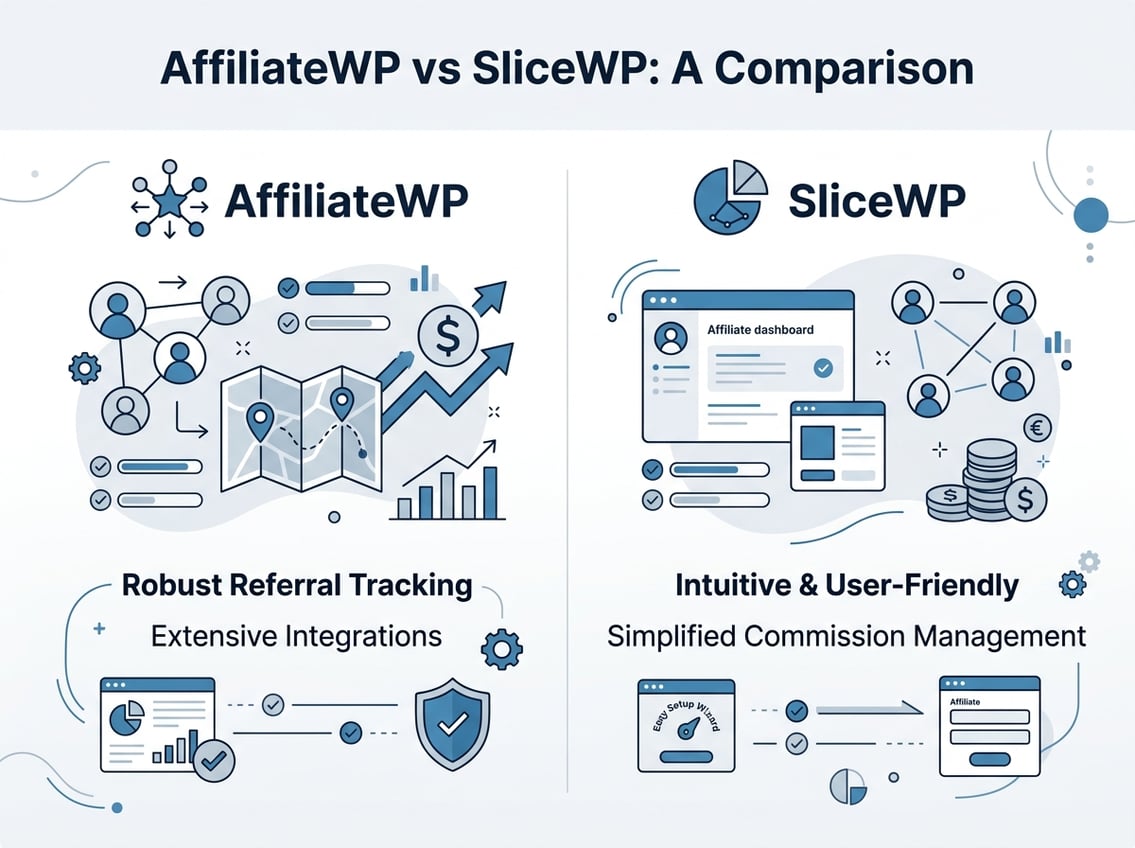
Picking between AffiliateWP vs SliceWP sounds straightforward until you start building your program and realize both tools have real gaps depending on what you need. If you run a WooCommerce store, a membership site, or a course platform, the plugin you choose will directly affect how you track commissions, pay affiliates, and scale your program.
This comparison covers the areas that actually matter: setup experience, tracking accuracy, commission flexibility, payout workflows, integrations, and pricing. It also addresses a question that comes up often but rarely gets a direct answer: which one supports multi-level commissions, and is either one actually built for MLM-style structures?
The short answer is neither tool handles true multi-level affiliate programs natively. For that use case, Ultimate Affiliate Pro is the better fit, and that gets covered in detail below.
Quick Verdict for Different Site Types
Both AffiliateWP and SliceWP cover the basics well, but they diverge on scalability, total cost of ownership, and how deeply they integrate with your existing stack. The right pick depends on your site type, not just feature lists.
Best Fit for WooCommerce Stores
AffiliateWP has the edge for WooCommerce affiliate programs that need advanced commission rules, coupon tracking tied to specific affiliates, and detailed reporting. Its WooCommerce integration is mature, and affiliate coupon tracking works without manual configuration.
SliceWP also supports WooCommerce integration and is a solid choice if you want a simpler setup without a large add-on budget. Its interface loads faster for smaller programs, and the flat-rate pricing means fewer surprises as you grow.
For mid-to-large WooCommerce stores where you need granular control over commission structures, AffiliateWP scales better. For smaller stores that want something clean and affordable, SliceWP competes well.
Best Fit for Membership and Course Sites
AffiliateWP connects with MemberPress, LearnDash, LifterLMS, and several other membership and LMS platforms. If your revenue comes from subscriptions or course enrollments, its recurring commissions add-on tracks those properly.
SliceWP covers a narrower set of integrations by default. It works with popular membership plugins, but you may hit limits faster if your setup involves multiple plugins or complex subscription billing.
When You Should Skip Both and Use Ultimate Affiliate Pro
If you need multi-tier commissions, built-in MLM-style downlines, or a more flexible structure for rewarding affiliates at multiple levels, neither AffiliateWP nor SliceWP is built for that. Ultimate Affiliate Pro handles multi-level commission setups natively without requiring workarounds or third-party add-ons. It also includes built-in social sharing rewards, performance bonuses, and lifetime commissions in a single package. Worth checking the pricing page if multi-level support is a priority for your program.
Setup Experience and Everyday Usability
Both plugins aim for a low-friction setup, but they take different approaches to the admin experience and affiliate-facing interface. The differences show up most in daily management tasks.
Setup Wizard and Initial Configuration
AffiliateWP walks you through an initial setup wizard that covers your license key, general settings, and integration selection. The process is direct, but the settings panel can feel dense once you get past the basics. There are a lot of options, and finding specific configurations sometimes requires digging through multiple tabs.
SliceWP’s setup wizard is arguably cleaner for first-time users. As noted in a comparison on WordPress.org, the plugin is designed to be quick to configure without sacrificing core functionality. You can have the program running in under an hour.
Affiliate Registration, Approval, and Onboarding
Both plugins let you choose between automatic and manual affiliate approval. AffiliateWP gives you more control over the registration form fields and approval workflow, which is useful if you want to vet affiliates before giving them access.
SliceWP keeps registration simple by default. It works, but you get fewer built-in options for custom fields or conditional approval logic without add-ons.
For programs where affiliate quality matters, AffiliateWP’s approval controls give you more out of the box.
Admin Dashboard, Affiliate Area, and Affiliate Dashboard
AffiliateWP’s admin dashboard gives you real-time data on referrals, commissions, and affiliate performance. The affiliate area your affiliates see is functional, though its design reflects the plugin’s longer development history and feels more utilitarian.
SliceWP’s affiliate dashboard has a more modern look. The affiliate portal feels closer to a purpose-built web app than a standard WordPress page. For affiliates who are active and checking stats regularly, SliceWP’s interface is easier to navigate at a glance.
If the affiliate experience matters for recruitment and retention, SliceWP’s affiliate area is the better-looking option.
Tracking, Commissions, and Payout Workflows
Tracking accuracy and commission flexibility are where these two plugins diverge most. Getting this layer right is what separates a program that scales from one that creates support headaches.
Affiliate Tracking, Cookie Rules, and Coupon Attribution
AffiliateWP uses cookie-based tracking with configurable cookie duration. You set how long a cookie stays active, and the plugin attributes conversions accordingly. Its affiliate coupon tracking is a standout feature: you can tie a specific coupon code to an affiliate, so sales made with that code get credited even if no cookie is present.
SliceWP also supports cookie tracking and affiliate link attribution. Coupon tracking is available but requires an add-on depending on your plan. For cross-device attribution, neither plugin offers a fully native solution, which is a known limitation of cookie-based systems.
If coupon-driven affiliate programs are central to your marketing, AffiliateWP handles that workflow better out of the box.
Commission Structures for One-Time and Recurring Revenue
AffiliateWP supports flat-rate and percentage-based commissions, custom commission rates per affiliate, sitewide commissions, and recurring commissions through an add-on. The recurring commission support is critical if you run subscriptions, as it lets you pay affiliates on every renewal, not just the first sale.
SliceWP supports similar commission structures and includes recurring commissions as part of its bundled feature set for subscription-based products. You do not need a separate add-on for that, which is a practical advantage for membership or SaaS-style sites.
For customizable commission structures across product categories or individual affiliates, AffiliateWP gives you more granular control. SliceWP is simpler to configure but less flexible at scale.
Mass Payouts, PayPal Payouts, and Automatic Payout Options
AffiliateWP offers an integrated payouts service that lets you pay affiliates directly via credit card or bank transfer from the admin dashboard. This is a significant convenience for programs with many active affiliates who need regular payouts.
SliceWP takes a different approach. It generates a mass pay file for PayPal, which you then upload through your PayPal account to process bulk payouts. It works, but it adds a manual step compared to AffiliateWP’s integrated option.
As noted in a manager-focused payout comparison, AffiliateWP’s integrated payout service removes friction for programs where automatic payouts and speed matter. If PayPal mass payouts are enough for your workflow, SliceWP’s approach is adequate.
Integrations, Add-Ons, and Growth Flexibility
Your affiliate plugin needs to work cleanly with everything else on your site. Both tools cover the major bases, but they differ in how far that coverage extends.
Core Commerce and Membership Integrations
AffiliateWP integrates with WooCommerce, Easy Digital Downloads, MemberPress, Restrict Content Pro, LearnDash, LifterLMS, and several other plugins. Its WooCommerce integration and Easy Digital Downloads integration are well-tested and widely used.
SliceWP covers WooCommerce and a selection of membership and payment plugins, but the integration library is smaller. If your site uses a combination of tools such as a membership plugin, a course plugin, and a custom checkout flow, AffiliateWP is more likely to handle all of them cleanly.
API and Automation Options
AffiliateWP includes a REST API, which lets you connect it to external tools or build custom workflows. Zapier integration is available through third-party connections, giving you access to automation with email marketing tools and CRMs.
SliceWP has API access as well, but the ecosystem around it is less developed. If automation is a core part of how your program runs, AffiliateWP gives you more to work with.
Plugin Add-Ons and Long-Term Extensibility
AffiliateWP has a large library of first-party add-ons covering things like affiliate tiers, lifetime commissions, performance bonuses, and fraud prevention. Many of these are only available on higher-tier plans, which affects total cost of ownership as your needs grow.
SliceWP bundles more features into its base plans, which reduces the need to layer on add-ons for common features. For growing programs that want predictable costs, that bundling model is practical.
Pricing, Support, and Real Ownership Costs
Sticker price rarely tells the full story for affiliate plugins. What you actually pay depends on which add-ons you need, how many sites you run, and whether renewal discounts apply.
Base Pricing Versus Feature Depth
AffiliateWP starts at around $149 per year for a single site. Higher-tier plans unlock add-ons like multi-tier commissions, recurring commissions, and the integrated payouts service. For businesses that need those features, the effective cost is higher than the entry price suggests.
SliceWP’s pricing is structured to include more out of the box. You get recurring commissions, multi-level affiliate support, and core integrations without needing to upgrade to access them. For what you get at each price point, SliceWP often delivers more value per dollar for smaller programs.
Premium Support and Update Model
Both plugins include support and updates with an active license. AffiliateWP has a larger support team and more documentation given its longer history and larger user base. SliceWP’s support team is smaller but has a reputation for responsive, personal responses.
Neither plugin offers a lifetime license, so you pay annually for continued updates and support.
What You Actually Pay as Your Program Grows
The honest picture: if you run AffiliateWP and need the recurring commissions add-on, multi-tier support, and the integrated payout service, your annual cost can climb significantly above the base price. With SliceWP, those features tend to be included at lower plan tiers.
For complex programs with many affiliates, multiple commission rules, and automation needs, neither plugin is cheap when you factor in everything required. This is where looking at Ultimate Affiliate Pro’s pricing makes sense as a bundled alternative with multi-level support built in from day one.
MLM Reality Check and the Better Option for Multi-Level Plans
Multi-tier and multi-level are terms that get used interchangeably, but they describe different structures. Knowing the difference prevents a costly setup mistake.
Why Multi-Tier Commissions Are Not the Same as Native MLM
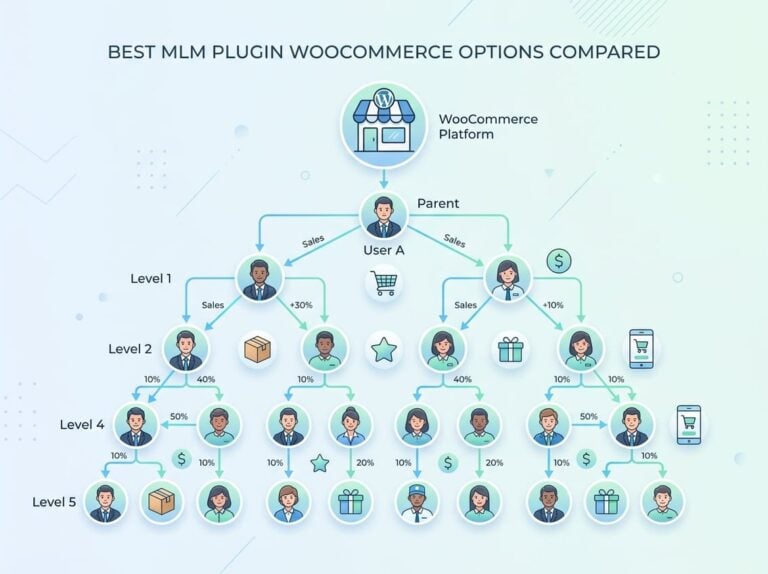
Multi-tier commissions mean affiliate A earns a commission when affiliate B (whom A referred) makes a sale. That is a referral incentive layer, not a true MLM structure. MLM involves unlimited or deep downline levels, rank advancements, and complex compensation plans tied to group performance.
AffiliateWP supports up to five tiers of commissions through its add-on. SliceWP supports multi-level affiliates as well, though the structure is simpler and less configurable than AffiliateWP’s system.
Limits of AffiliateWP and SliceWP for MLM Structures
Neither plugin is designed for true MLM compensation plans. You can approximate a shallow multi-level structure with their tier systems, but rank-based bonuses, downline volume tracking, and complex payout calculations are not native features in either tool.
Trying to build an MLM-style program on top of these plugins typically requires custom development, which adds cost and maintenance burden.
Why Ultimate Affiliate Pro Fits Better for Multi-Level Commission Setups
Ultimate Affiliate Pro is built with multi-level commissions as a core feature, not an add-on. You can define commission rates at multiple levels, set performance bonuses tied to milestones, and manage affiliates across tiers from a single dashboard.
It also includes fraud prevention tools, real-time reports, and performance reports without requiring separate purchases. For WordPress site owners who need genuine multi-level affiliate program management, it covers ground that AffiliateWP and SliceWP simply do not reach natively. You can review what is included at the Ultimate Affiliate Pro features page before committing.
Frequently Asked Questions
Which plugin is easier to set up for a WooCommerce affiliate program without extra add-ons?
SliceWP is faster to configure for a basic WooCommerce affiliate program since it includes more features in its base plans without requiring additional purchases. AffiliateWP’s setup is also straightforward but may require add-ons to unlock features like recurring commissions that SliceWP includes by default.
Which one gives you better control over affiliate approval, payouts, and fraud prevention?
AffiliateWP offers more granular control over affiliate approval workflows and includes dedicated fraud prevention tools that SliceWP does not match at the same level. For programs where affiliate quality and payout accuracy are critical, AffiliateWP’s controls are more robust.
How do their tracking methods compare for coupons, referral links, and cross-device attribution?
Both plugins use cookie-based tracking for affiliate links, but AffiliateWP’s affiliate coupon tracking is more fully developed out of the box, allowing you to credit sales to an affiliate based on coupon use even without a cookie. Cross-device attribution is limited in both tools since neither offers a native fingerprinting or cross-device solution.
Which option plays nicer with common WordPress plugins like membership, subscriptions, and page builders?
AffiliateWP has a broader integration library that includes MemberPress, LearnDash, LifterLMS, and Easy Digital Downloads alongside WooCommerce. SliceWP covers the main integrations but has a narrower ecosystem, so if your site uses several plugins together, AffiliateWP is more likely to connect cleanly with all of them.
What are the real ongoing costs once you factor in paid add-ons you’ll actually need?
With AffiliateWP, recurring commissions, multi-tier support, and the integrated payouts service all sit behind higher-tier plans or separate add-ons, which raises the effective annual cost. SliceWP bundles more features into its base price, making it more predictable for growing programs. If you need multi-level commissions natively, Ultimate Affiliate Pro offers a bundled pricing model worth comparing directly.
Which plugin makes it easier to pay affiliates via PayPal, Stripe, or store credit without manual work?
AffiliateWP’s integrated payouts service lets you pay affiliates directly from the WordPress dashboard via credit card or bank transfer, reducing manual steps. SliceWP generates a PayPal mass pay file that you upload manually through your PayPal account, which works but requires more effort per payout cycle.